dvd
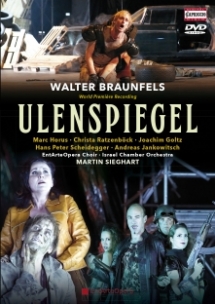
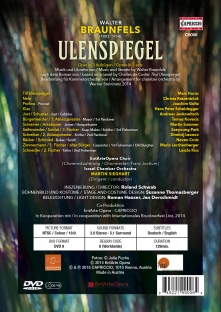
WALTER BRAUNFELS
Marc Horus · Christa Ratzenböck · Joachim Goltz · Andreas Jankowitsch · Israel Chamber Orchestra · Martin Sieghart · INSZENIERUNG / DIRECTOR: Roland Schwab
Till Ulenspiegel // Marc Horus · Nele // Christa Ratzenböck
Profoss // Joachim Goltz · Klas // Hans Peter Scheidegger
Jost / Schuster // Andreas Jankowitsch
Bürgermeister / 1. Ablasspriester // Tomas Kovacic· Schreiner / Arkebusier // Martin Summer
EntArteOpera Chorus · Israel Chamber Orchestra
Martin Sieghart (Dirigent / conductor
DIRECTOR: Roland Schwab
STAGE AND COSTUME DESIGN: Susanne Thomasberger
LIGHT DESIGN: Roman Hauser, Jan Derschmidt
PICTURE FORMAT: NTSC / Colour / 16:9
SOUND FORMATS 2.0 Stereo · 5.1 Surround
SUBTITLES: Deutsch / English
Charles de Coster, whose novel Thyl Ulenspiegel provided the source for Braunfels’ opera, narrates one of the gloomiest chapters in human history, the
Spanish Inquisition in 16th-century Flanders, via the very figure of a world-famous clown. He depicts an apocalyptic panorama, in which the Seven Deadly Sins of the Bible, like the riders of the Apocalypse, befall the last remnants of mankind. In this world of downfall, the composer Walter Braunfels sets his focus on the origins and development of resistance in general. Ulenspiegel becomes the trenchant case study of an apolitical daredevil who undergoes a radical personal transformation as a result of the terror befalling his family. Promoted to become the leader of political resistance, his mind only knows one thing: all-encompassing revenge.
Weitere Bilder
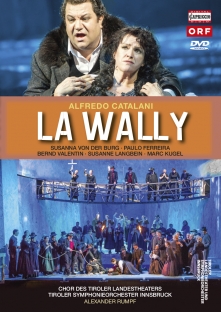
Alfredo Catalani: La Wally
MARC KUGEL · SUSANNA VON DER BURG · PAULO FERREIRA · BERND VALENTIN · CHOR und EXTRACHOR DES TIROLER LANDESTHEATERS · TIROLER SYMPHONIEORCHESTER INNSBRUCK · ALEXANDER RUMPF
ALFREDO CATALANI (1854-1893)
LA WALLY
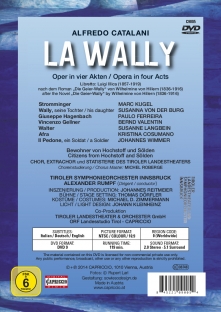
Oper in vier Akten / Opera in four Acts
Libretto: Luigi Illica (1857-1919)
after the Novel „Die Geier-Wally“ by Wilhelmine von Hillern (1836-1916)
MARC KUGEL · SUSANNA VON DER BURG · PAULO FERREIRA · BERND VALENTIN
CHOR und EXTRACHOR DES TIROLER LANDESTHEATERS
TIROLER SYMPHONIEORCHESTER INNSBRUCK
ALEXANDER RUMPF (Dirigent / conductor)
INSZENIERUNG / PRODUCTION: Johannes Reitmeier
BÜHNE / STAGE SETTING: Thomas Dörfler
KOSTÜME / COSTUMES: Michael D. Zimmermann
Co-Produktion
TIROLER LANDESTHEATER & ORCHESTER GmbH – ORF Landesstudio Tirol – CAPRICCIO
PICTURE FORMAT: NTSC / Colour / 16:9
SOUND FORMATS: 2.0 Stereo · 5.1 Surround
SUBTITLES: Italian / Deutsch / English
DURATION: 119min.
DVD FORMAT: DVD 5 · REGION CODE: 0 (Worldwide)
A powerful woman – powerful material
“Once upon a time there was a young woman who was more courageous than all the men in her mountain village”. What sounds like a fictitious story really happened. The young woman was Anna Stainer-Knittel, born as a gunsmith’s daughter in the Lech Valley in Tyrol on 28 July 1841. She proved her courage and independence of mind time and again in later life. For in her preparations for the novel, Wilhelmine von Hillern concerned herself not only with Anna Stainer-Knittel’s experiences, but also intensively with people’s lives in the mountains at that time. Her Geier-Wally also integrated motifs from Tyrolean legends. The material reached the opera stage via the publication of the novel as a serial in the Milan paper La Perseveranza. It was there that the Italian composer Alfredo Catalani became aware of it. He was able to obtain Luigi Illica as the librettist. La Wally was first staged in La Scala in Milan on 20 January 1892 and met with a great deal of approval. After the third performance, Catalani wrote to: ‘The house was wonderful and the prelude to Act II was repeated. At the end of the opera, I received general, long (and I must really say so) enthusiastic ovations. The impresario is very happy and says the opera will make its way through all the theatres’.
Youtube
Weitere Bilder
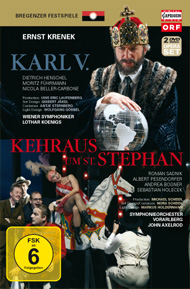
ERNST KRENEK (1900–1991)
World Premiere Recordings for DVD-Video
DVD 1: KARL V. (1933)
DVD 2: KEHRAUS UM ST. STEPHAN
(LAST DANCE ARROUND ST. STEPHENS)
Subtitles: Deutsch English / Français
NTSC – worldwide 16:9 – 5.1 / PCM Stereo
DVD 1: KARL V. (1933)
Dietrich Henschel, Moritz Fährmann, Cassandra McConnell, Andreas Herrmann, Hubert Francis Wiener Symphoniker , Lothar Koenigs,
Conductor Production: Uwe Eric Laufenberg
DVD 2: KEHRAUS UM ST. STEPHAN
(LAST DANCE ARROUND ST. STEPHENS)
Satire mit Musik in 2 Teilen op.66 (1930)
Andrea Bogner, Sebastian Holecek, Roman Sadnik Symphonieorchester Vorarlberg,
John Axelrod: Conductor
ERNST KRENEK: Karl V.
Auf eigenen Wunsch von der Kaiserwürde entbunden, bilanziert der dem Tod entgegensehende Karl V. sein Dasein – in einer Rückschau auf die wesentlichen Stationen seiner Biographie, wohlwollend bis kritisch unterstützt von dem jungen Beichtvater Juan de Regla. Der Ex-Regent hält sein Leben für gescheitert, da es ihm nicht gelungen sei, die Welt im Zeichen Christi zu einen. Nicht einmal Luthers Reformation und die Kirchenspaltung habe er verhindern können. Sich der Tatsache bewusst, ein politisches „Flickwerk“ zu hinterlassen und ein Reich, in dem die Sonne niemals unterging, der Dunkelheit preisgegeben zu haben, stirbt Karl V. – mit der bescheidenen Hoffnung, dass er wenigstens diese letzte seiner Aufgaben zu Gottes Zufriedenheit bewältigen möge.
Die Entscheidung, in Karl V. erstmals die Zwölftonmethode anzuwenden, ließ Krenek nicht nur die erste abendfüllende „Zwölftonoper“ der Musikgeschichte schreiben, sie half ihm auch aus seiner schöpferischen Krise. Der politischen Katastrophe konnte sich der Komponist freilich nicht entziehen. Eine Intrige der nazifreundlichen Heimwehr brachte zunächst die für 1934 angesetzte Uraufführung von Karl V. zu Fall, und vier Jahre später musste Krenek vor den Nationalsozialisten in die USA fliehen.
Released from the weight of authority, close to death, Charles V meditates on the key stations of his life. He is helped in doing so by the young confessor: Juan de Regla. Having failed to unite Christendom the former sovereign regards his life as a failure. He even proved incapable of preventing Luther’s Reformation and the schism within the church. Conscious of leaving a political “patchwork” and an empire (upon which the sun never set) in darkness behind Charles V dies with the modest hope that he will at least manage this last act of duty to God’s satisfaction.
The decision to use a tone row meant not only that Krenek created the first “tone row opera”, it helped him get out of his creative crisis. The political disaster however was unavoidable. An intrigue by the “Heimwehr” (Home Guard), which was sympathetic to the Nazis, prevented the opera being staged in 1934. Four years later Krenek was forced by the Nazis to flee to America.
Kehraus um St. Stephan
Der Rittmeister Ottmar Brandstetter gehört zu jenen Menschen, deren Leben infolge des Ersten Weltkriegs (1914-1918) nur noch ein Trümmerfeld ist. Sozial vereinsamt, ohne berufliche Perspektive, unternimmt er einen Versuch der Selbsttötung – erfolglos, aber folgenreich: Sein Retter, der Weinbauer Sebastian Kundrather, bietet ihm nicht nur ein neues Zuhause, sondern auch eine Aufgabe – als Helfer bei der Pflege und Ernte der Reben. Im Gegensatz zu Brandstetter, der anfangs als Verlierertyp erscheint, ist sein Freund Alfred Koppreiter in den Augen der Gesellschaft ein Kriegsgewinnler, ein erfolgreicher Geschäftsmann. Doch am Ende verliert Koppreiter infolge einer Intrige alles, sein Vermögen, seine Geliebte (Maria alias Ria) und schließlich – sich selbst erschießend – sein Leben, während Brandstetter nicht nur den Weinberg Kundrathers erbt, sondern auch die irrtümlich für untreu gehaltene Elisabeth zurückgewinnt.
In Kehraus um St. Stephan wandte sich Krenek nun wieder der Dur-Moll-Tonalität zu. „Noch einmal“, kommentierte der Komponist in seiner 1953 publizierten Selbstdarstellung, „hatte ich das romantische Rüstzeug mobilisiert für ein Bühnenspiel, das die politische und soziale Krise Wiens in der Nachkriegszeit behandelte. Während die Musik immer noch den Schubert-Klang des Reisebuchs aufwies, war das Libretto scharf kritisch mit Bezug auf lokale Verhältnisse und besonders die Haltung Deutschlands gegenüber Österreich.“
The cavalry captain Ottmar Brandstetter is one of those whose lives have been ruined by the First World War (1914-1918). Lonely, without hope of a career, he tries to commit suicide but fails. His savior: the wine grower Sebastian Kundrather, offers him not only a new home but a new task – as a helper in the care and harvesting of his grapes. In contrast to Brandstetter, who seems at the beginning to be a loser, his friend Alfred Koppreiter, a successful businessman, is regarded as a war profiteer. At the end though Koppreiter loses, as a result of an intrigue, not only his fortune and love (Maria/Ria) but his life, while Brandstetter not only inherits Kundrather‘s vineyards, he regains the love of Elisabeth, who he erroneously believed to have been unfaithful.
In “Kehraus um St. Stephan” returned Krenek to the major-minor tonality and composed in a neo-romantic style. “Once more I mobilized” the composer wrote in his Selbstdarstellung of 1953, “the romantic tools for a work for stage that dealt with the political and social crisis in post war Vienna. While the music still exhibited the influence of the Schubert-like Reisebuch the libretto was highly critical of the local situation and especially the attitude of Germany toward Austria.”
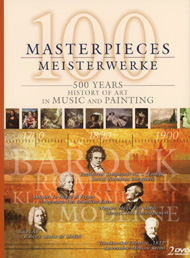
100 MEISTERWERKE
100 MASTERPIECES
500 Years History Of The Arts in Music and Painting
An extensive collection of the most beautiful paintings and most famous masterpieces of classical music in 500 years of the history of art.
Interactive lexicon with articles, with options on paintings and painters, composers and compositions.
From the renaissance to baroque, classic, romance eras to the early modern era of the 20th century.
More than 415 min. of film and music
More than 500 lexicon pages in 4 languages (German, English, French, Spanish)
HIGH-RESOLUTION COMPUTER ANIMATION
5.1 DOLBY DIGITAL SOUND FORMAT
2DVD-Set · PC: 32
PAL Version: 92 002 EAN: 4006408920021
NTSC Version: 93 500 EAN: 4006408935001
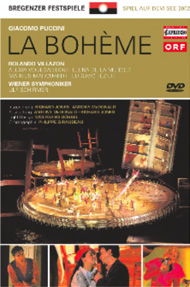
Giacomo Puccini · La Bohéme
Spiel auf dem See 2002
OPEN AIR · Live Production
Oper in vier Akten
Opera in four acts
ROLANDO VILLAZON · ALEXIA VOULGARIDOU · ELENA DE LA MERCED · LUDOVIC TÉZIER · WIENER SYMPHONIKER · ULF SCHIRMER
Inszenierung: RICHARD JONES, ANTONY McDONALD
Co-Produktion BREGENZER FESTSPIELE – ORF – NHK
SUBTITLES: Deutsch / English / Français / Italiano PICTURE FORMAT: NTSC / Colour / 16:9 SOUND FORMATS: 2.0 Stereo Dolby Digital REGION CODE: 0 (worldwide)