cd
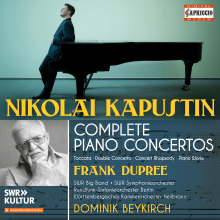
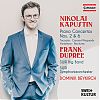
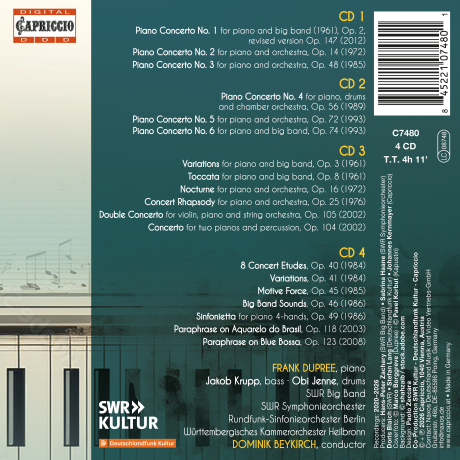
KAPUSTIN: Complete Piano Concertos
SWR Big Band · SWR Symphonieorchester · Rundfunk-Sinfonieorchester Berlin · Württ. Kammerorchester Heilbronn · Dominik Beykirch
“…our life is like jazz improvisation; it should always be spontaneous, always in the moment, and always free.” (Nikolai Kapustin) Mission accomplished! After six years of rehearsals, concerts, and productions, all six piano concertos by the Russian jazz wizard Nikolai Kapustin are now available as recordings. Concertos Nos. 1 and 3, along with the no less virtuosic 8 Concert Etudes Op. 40, are released here for the first time, thereby completing this successful cycle. Drawing a parallel to one of the most prominent figures of symphonic jazz, Kapustin is often described as a “Russian following in Gershwin’s footsteps.” Frank Dupree has tirelessly followed that path, finally presenting us this significant gap in musical history.
Hörprobe
Weitere Bilder

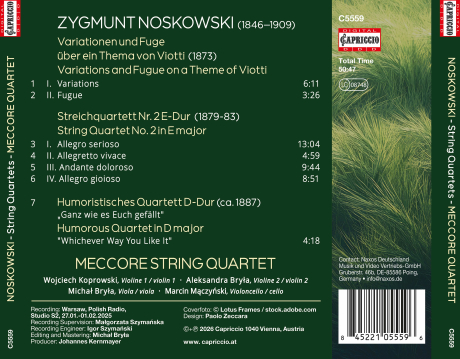
NOSKOWSKI
Meccore String Quartet
Zygmunt Noskowski, the influential Polish conductor and composer, is perhaps better remembered for his role as a teacher and mentor to later luminaries such as Karol Szymanowski and Mieczysław Karłowicz – and for his connection to Stanisław Moniuszko – than for his own compositions. Yet for much of the 19th century, he was Poland’s leading exponent of modern music and his works are central to the Polish tradition. After the Capriccio recordings of his Symphonies (CD C5509 and C5547) this album presents some of his string quartets and shows us again a veritable picture book of Polish romanticism.
Hörprobe
Weitere Bilder

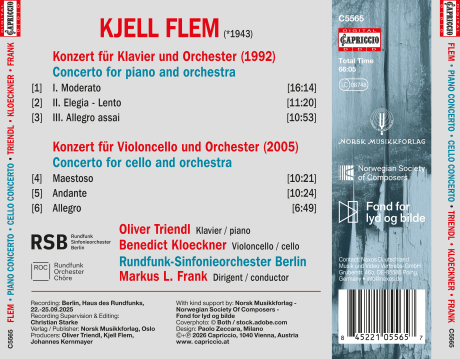
KJELL FLEM
Oliver Triendl, piano · Benedict Kloeckner, cello · Rundfunk-Sinfonieorchester Berlin · Markus L. Frank
Hörprobe
Weitere Bilder
Kurt Weill: Street Scene
Giselle Allen · Robert Hayward · Chorus and Orchestra of Opera North · James Holmes
Today Street Scene is Kurt Weill’s most frequently revived American stage work.
A polystylistic blending of operatic arias and ensembles, musical comedy songs and dances, dramatic dialogue both unaccompanied and underscored, and extraordinary emotional drama, Street Scene is arguably Weill’s breakthrough. Though Elmer Rice’s play was set in the 1920s, the popular music references are pure 1940s style (Glenn Miller, Rodgers and Hammerstein). After the successful release of "Love Life" (Capriccio C5550) this recording fills up the meanwhile large Kurt-Weill-Catalogue of Capriccio, again with a powerful cast from Opera North.
Hörprobe
Weitere Bilder
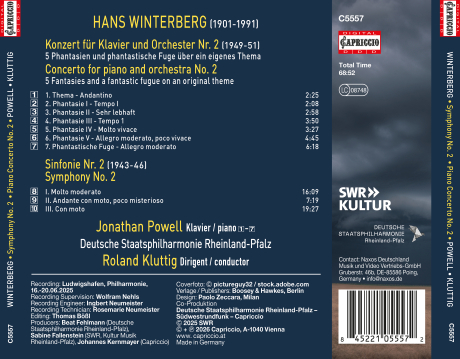
HANS WINTERBERG
Jonathan Powell, piano · Deutsche Staatsphilharmonie Rheinland-Pfalz · Roland Kluttig